
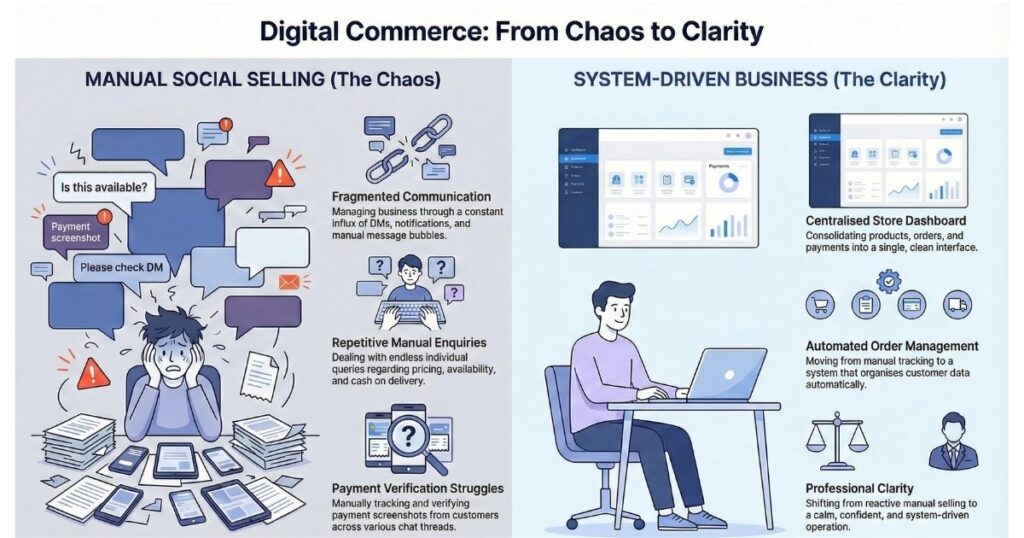
In this guide, we break down the real problems with Instagram DM selling, explain why most Indian sellers hit a growth ceiling, and show how moving to a Shopify store actually solves it step by step.
If you want to build a real brand, own your online presence, and grow without being glued to your phone all day, this guide is for you.
The Reality of Instagram DM Selling
7:30 AM.
You open Instagram and see 47 unread messages.
“Price?”
“COD available?”
“Still available?”
“Delivery time?”
“Bhaiya discount milega?”
You start replying. One by one. The same questions you answered yesterday. And the day before.
By 11 AM, you’ve sent 60 messages but closed only 3 sales.
By evening, you’re exhausted — not from building your business, but from keeping it alive manually.
Sales happen. But only because you are constantly available.
Sound familiar?
The Instagram Selling Trap Nobody Talks About
Here’s what most people won’t tell you:
Instagram selling works beautifully… until it doesn’t.
In the beginning, every sale feels like a win. You’re hustling, connecting, building relationships through DMs.
Then something shifts.
You’re working harder than ever, but:
- Revenue plateaus around the same number every month
- You can’t take a day off without losing sales
- Your phone battery dies by 2 PM from constant messaging
- You’re one Instagram restriction away from zero income
You’ve hit the ceiling.
And the worst part? You don’t realize the ceiling exists until you’re already stuck under it.
What Actually Happens When You Scale on Instagram Alone
Let me show you the math most sellers don’t see:
Month 1-3: 20-30 orders/month
You handle everything. It’s manageable.
Month 4-6: 50-70 orders/month
You’re constantly online. It’s tiring but doable.
Month 7+: 100+ potential customers/month
You can’t reply fast enough. Messages pile up. Serious buyers leave without telling you.
The breaking point?
When your effort increases but your revenue doesn’t.
You’re working 12-hour days for the same ₹80,000/month.
That’s not growth. That’s a manually-operated hamster wheel.
The Day Priya’s Reel Got 200K Views (And Ruined Her Week)
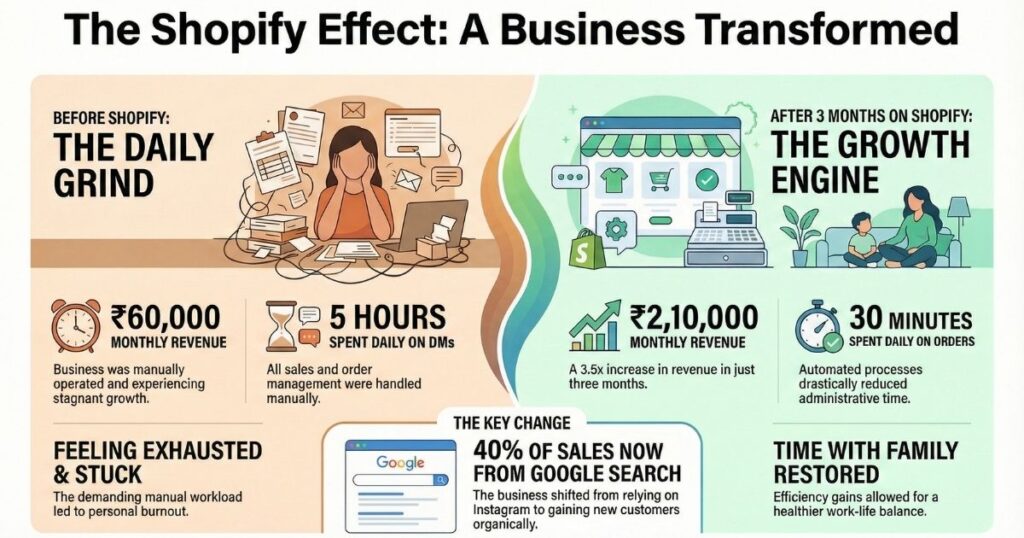
Priya sells handmade jewelry. She’d been steadily making ₹60K/month through Instagram.
Then one of her reels went viral.
The result?
- 380 DMs in 48 hours
- 200+ comments asking different questions
- Her phone crashed twice
- She replied for 16 hours straight
Sales that week: ₹8,000.
Less than a normal week.
Why?
Because virality without systems doesn’t create revenue. It creates chaos.
The serious buyers who messaged at 11 PM? Gone by morning.
The ones who asked “price?” and didn’t get a reply in 30 minutes? They bought from someone else.
Attention without infrastructure is just noise.
After that week, Priya built a proper website. Same Instagram content. Same DM strategy for building connection.
But now? Her bio says: “Shop: [website link]”
Next viral reel: ₹1.2L in sales.
Same views. Different system.
The 5 Problems You Don’t See (Until It’s Too Late)
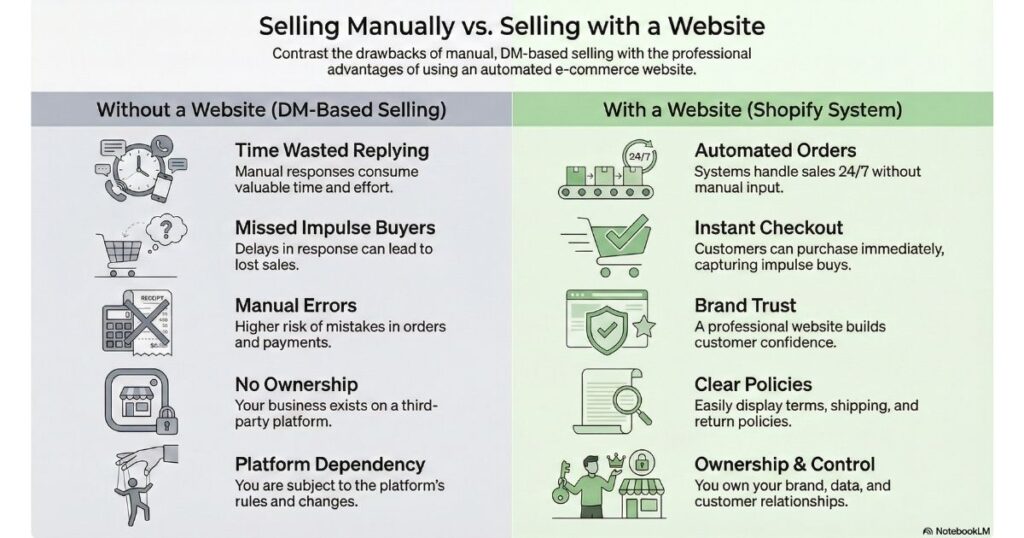
1. You Don’t Own the Platform
Your entire business lives on Instagram’s terms.
One algorithm change, one policy update, one false report from a competitor — and you’re locked out.
I’ve seen sellers lose access to accounts with 40K followers overnight.
No warning. No appeal. No backup.
Your customer list? Gone.
Your order history? Gone.
Your income? Gone.
2. Trust Is Invisible in DMs
When a customer lands on your Instagram:
- They can’t see your full catalog easily
- They don’t know your return policy
- They can’t tell if you’re professional or a side hustle
- They have no way to verify you’re legitimate
In India especially, buyers compare before they commit.
Without a proper storefront, you’re asking them to trust you based on… a few grid posts and your reply speed?
That’s a hard sell.
3. Manual Systems Compound Risk
Right now, you might be tracking:
- Payments through screenshots
- Inventory in your head
- Customer addresses in notes
It works… until:
- You ship the wrong order
- A payment screenshot is fake
- You forget who paid and who didn’t
- A customer claims they never received their order (and you have no proof)
These problems don’t show up when you’re doing 20 orders/month.
At 100 orders/month? They’re expensive mistakes.
4. You Can’t Capture Impulse Buyers
Someone sees your post at 1 AM. They’re ready to buy right now.
But… you’re asleep.
By morning, the impulse is gone. They’ve scrolled past 400 other posts.
Every hour of delay = lower conversion.
With Instagram-only selling, you lose:
- Night-time buyers
- Early morning browsers
- Weekend shoppers while you’re with family
- International customers in different time zones
A website closes sales while you sleep.
5. Your Time Becomes the Product
This is the hidden cost nobody calculates.
How much is your time worth?
If you spend 6 hours/day on DMs and make ₹80,000/month, you’re earning ₹444/hour.
A delivery person earns more.
The goal isn’t to work more. It’s to earn more while working less.
Why Indian Sellers Feel This Even More
Here’s what I’ve learned working with 200+ Indian Instagram sellers:
Indian customers don’t just want products. They want proof.
They want to see:
✓ Clear pricing (no hidden costs)
✓ Organized categories (not endless scrolling)
✓ Professional policies (returns, exchanges, shipping)
✓ Payment security (not just “send screenshot”)
✓ Social proof (reviews, testimonials)
Without a website, you’re asking them to take a leap of faith.
And in a market where trust is earned slowly, that’s a massive disadvantage.
Here’s the truth most won’t say:
Systems don’t reduce personal connection in India. They increase trust.
A customer who sees your professional website + your personal Instagram stories?
That’s the winning combination.
They trust your system. They connect with your story.
“But I’m Not Technical” (And Other Fears That Keep You Stuck)
Let me guess your objections:
“I don’t know how to build a website”
Neither did the 200+ sellers we’ve helped.
If you can:
- Upload photos to Instagram
- Write captions
- Reply to DMs
You can manage a Shopify store.
The setup takes one weekend. The daily management takes 15 minutes.
“Websites are expensive”
Let’s do the math:
Instagram-only selling hidden costs:
- Lost sales from delayed responses: ₹10,000/month
- Time spent on repetitive DMs: 180 hours/month
- Mental exhaustion: Priceless (but ruins everything)
Shopify store costs:
- One-time setup: ₹12,000-15,000
- Monthly cost: ₹2,500-3,500
Break-even timeline: Usually 2-3 weeks.
After that? Pure leverage.
“I’ll need a developer forever”
You won’t.
Once your store is set up:
- Adding products = uploading to Instagram (easier, actually)
- Processing orders = clicking buttons
- Updating inventory = changing numbers
You needed more technical skill to figure out Instagram Reels.
“My customers prefer DMs”
They don’t prefer DMs.
They prefer convenience.
Right now, DMs are the only option you’ve given them.
Watch what happens when you add a “Shop Now” link:
- 50% will still DM (keep that connection!)
- 50% will buy directly (while you’re offline)
You’re not replacing DMs. You’re adding options.
What Actually Changes When You Add a Website
I asked 47 sellers who made the shift. Here’s what they noticed in the first 30 days:
Week 1:
“I’m sleeping through the night without checking messages”
“Someone bought at 3 AM. I woke up to a completed order”
Week 2:
“I’m spending 4 hours/day on DMs instead of 8”
“The same questions stopped coming. They check the website first”
Week 3:
“A customer left a review. Three people bought the same product that day”
“I took Sunday off. Still made ₹12,000”
Week 4:
“My mom asked when I’m getting a ‘real job.’ I showed her my dashboard. She stopped asking.”
The pattern?
Instagram stays the same. You’re still posting, engaging, building community.
But now the business runs separately from your availability.
The Simple 6-Step Shift
You don’t need a tech degree. You need a weekend and a plan.
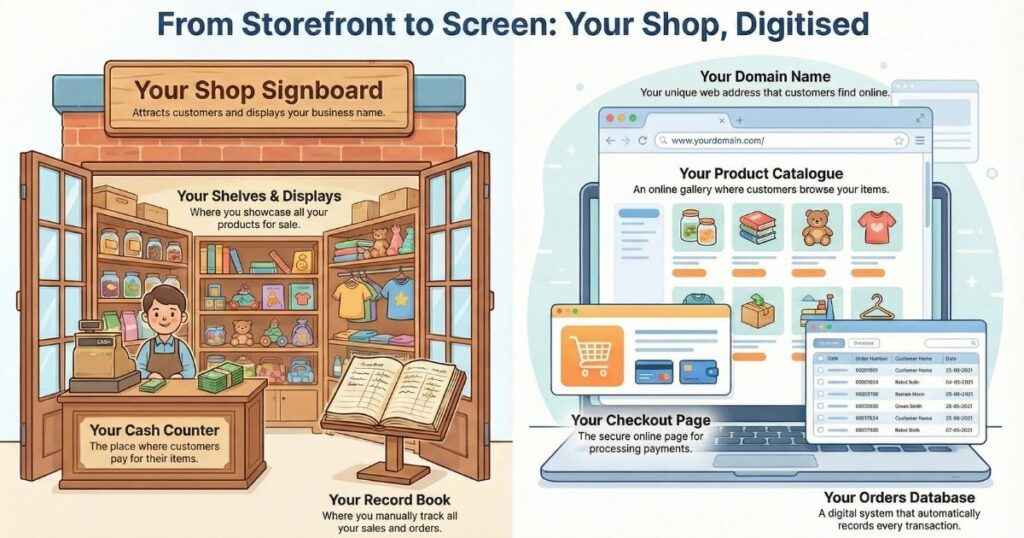
Step 1: Buy Your Domain (30 minutes)
- Your brand name + .in or .com
- Cost: ₹800-1,500/year
Step 2: Choose Shopify’s Basic Plan (5 minutes)
- Start with the free trial. Test before committing.
- Cost: ₹2,500-3,500/month after trial
Step 3: Add Your Products (3-4 hours)
- Photos you already have
- Descriptions you’ve written 100 times in DMs
- Copy. Paste. Organize.
Step 4: Set Up Payments & Shipping (1 hour)
- COD, UPI, cards — all integrated
- Shipping rates by pin code — automatic
Step 5: Add Trust Elements (2 hours)
- Return policy
- Shipping policy
- About page
- (Use templates — don’t overthink this)
Step 6: Connect Instagram & Go Live (30 minutes)
- Add shop link to bio
- Create a “Now you can shop 24/7” post
Total time: One focused weekend.
After that, Instagram brings traffic. Your website closes sales.
The Real Story: Priya’s ₹45,000 → ₹2.8L Journey
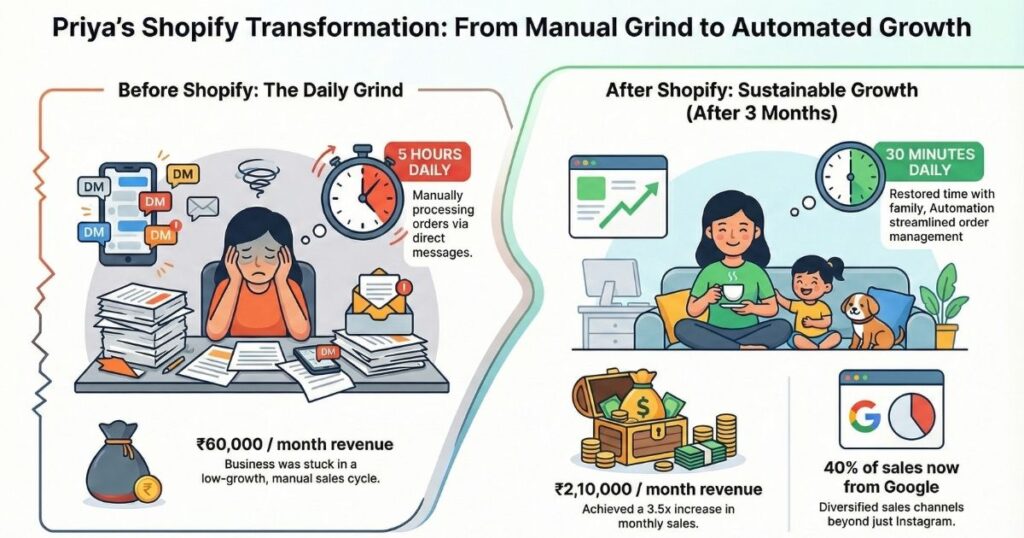
Priya sells fitness accessories. She was stuck at ₹40-60K/month for 8 months.
“I thought I just needed more followers,” he told me.
She had 18K followers. Engagement was good. But revenue wouldn’t budge.
The problem wasn’t reach. It was infrastructure.
Here’s what happened after he launched his Shopify store:
- Month 1: ₹73,000 (₹28K increase)
- Month 3: ₹1.4L
- Month 6: ₹2.1L
Same Instagram. Same content strategy.
The difference?
- Her viral reels now converted (not just got views)
- Customers could browse her full range (not just what’s in the grid)
- Repeat buyers could reorder in 2 clicks (not wait for DM replies)
- She ran his first sale (impossible to coordinate in DMs)
Her Instagram follower count barely changed.
Her systems did.
What You’re Actually Paying For By Staying Manual
Every month without a website, you’re losing:
- ₹15,000-40,000 in after-hours sales
- 180 hours in repetitive conversations
- Mental clarity (checking DMs every 30 minutes)
- Growth momentum (you can’t scale yourself)
- Professional credibility (serious buyers notice)
Manual feels cheaper because the cost is invisible.
But your exhaustion? That’s the price.
Your plateaued revenue? That’s the price.
Your inability to take a day off? That’s the price.
Instagram Is Your Megaphone. Your Website Is Your Store.
Think about any successful business:
- They use social media for attention
- They use their store for transactions
No one shops at a billboard.
No one builds a business in someone else’s comment section.
Instagram’s job: Get people interested
Website’s job: Make buying effortless
When you confuse the two, you get exhaustion without growth.
The Question That Changes Everything
Here’s what I ask every Instagram seller who’s on the fence:
“If your Instagram account got restricted tomorrow, would you still have a business?”
If the answer is no, you don’t have a business.
You have a platform dependency.
And platform dependencies are one policy change away from becoming unemployed.
Final Truth
You already have the hardest parts figured out:
✓ You know your product
✓ You understand your customers
✓ You can create content
✓ You can sell
The only thing missing is infrastructure.
And infrastructure isn’t complicated.
It’s just a decision you’ve been delaying.
Hustle has a ceiling.
Systems don’t.
When you’re ready to grow without burning out, structure changes everything.
Ready to build your Shopify store? Contact Us
Still have questions? Drop them in the comments. I read and reply to every single one.
P.S. — If you’ve been making ₹50K/month manually and think “that’s good enough,” ask yourself this: What if the same effort could get you to ₹2L? The gap between you and sellers already there isn’t talent. It’s just a system.